
For years, SAP customers have viewed the modernization of a legacy SAP BW system as a monumental undertaking. The common perception is that of an all-or-nothing upgrade—a complex, high-risk project required to unlock the benefits of the cloud. This narrative often involves a mandatory, resource-intensive conversion that can seem more daunting than the potential rewards.
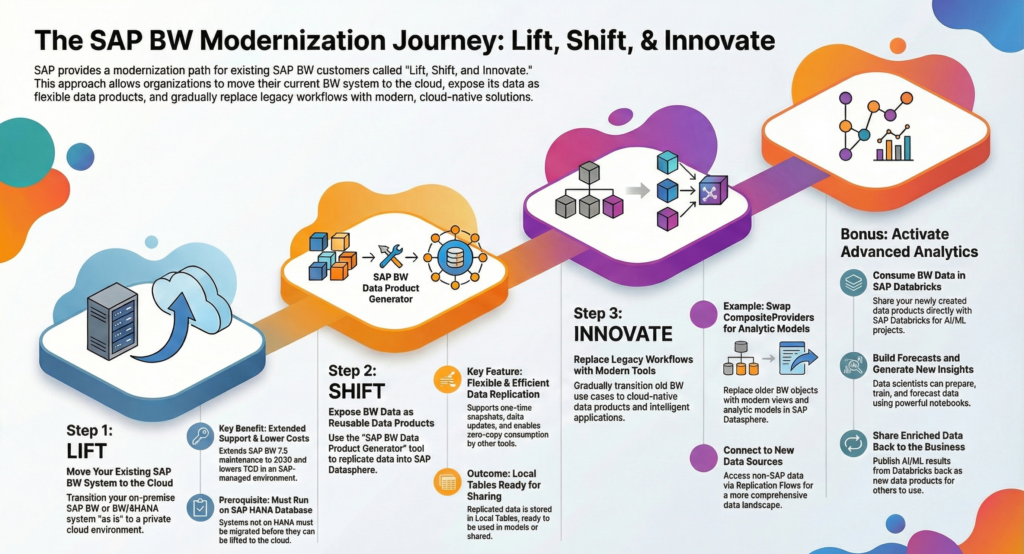
That entire paradigm has changed. SAP’s new “lift, shift, and innovate” approach within SAP Business Data Cloud fundamentally reframes the journey, introducing flexible, less disruptive pathways for modernization. It’s no longer about a single, massive leap but a series of strategic steps that allow you to move at your own pace, reduce initial risk, and start realizing value much sooner.
This article on Modernizing Your SAP BW will reveal four of the most impactful and counter-intuitive truths about this new modernization journey. Based directly on SAP’s latest strategy, these points challenge long-held assumptions and present a more agile and achievable future for your trusted SAP BW data.
——————————————————————————–
1. You Can Move to the Cloud Without Converting to SAP BW/4HANA First
Previously, organizations running SAP NetWeaver BW 7.5 faced a significant hurdle. To leverage modern cloud innovations, a full conversion project to SAP BW/4HANA was often a mandatory prerequisite, representing a major project that delayed the real goal of cloud integration.
The new reality offered by the “lift” phase is strategically profound. Organizations can migrate their existing SAP BW 7.5 system (version 7.5 SPS 24 or higher on an SAP HANA database) directly to the private cloud edition within SAP Business Data Cloud. This allows you to strategically decouple infrastructure modernization from application modernization. You can gain the TCO and operational benefits of an SAP-managed cloud environment first, while creating the space for a more thoughtful, phased application modernization journey later.
This critical shift in strategy is a key enabler for a more pragmatic modernization path.
Converting the SAP BW NetWeaver system to SAP BW/4HANA is not required for the move to SAP Business Data Cloud.
This approach dramatically lowers the barrier to entry for cloud modernization. By separating the cloud infrastructure initiative from the more complex application conversion, you reduce the initial scope, cost, and risk. This allows your organization to start realizing the benefits of a managed cloud environment much faster, setting the stage for subsequent innovation at a more considered pace.
——————————————————————————–
2. Buy More Time: Your BW 7.5 Maintenance Can Be Extended to 2030
One of the most surprising benefits of the “lift” approach is that moving to the cloud can extend the lifespan of your current system. By lifting an SAP NetWeaver BW 7.5 system to the private cloud, its mainstream maintenance is automatically extended from 2027 to 2030.
Instead of forcing a rapid transition, this cloud migration path buys your organization valuable strategic time. The deeper insight, however, is what you can do with that time. This extension enables a risk-mitigated, parallel-run strategy. As the source notes, it provides:
Extra time to consider the role of SAP BW and SAP BW/4HANA going forward.
This three-year extension is a strategic advantage. It allows your teams to gradually shift and rebuild critical use cases in SAP Datasphere while the legacy system remains fully supported. This ensures a seamless transition, validated at every step, rather than a high-pressure “big bang” cutover, dramatically de-risking the entire modernization program.
——————————————————————————–
3. Unleash Your Data Scientists with “Zero-Copy” Access to BW Data
The “shift” phase of the modernization journey breaks down the historic wall between the governed world of SAP and the agile world of data science. It introduces a powerful, deeply integrated tool: the SAP BW Data Product Generator. This utility, managed via the familiar SAP GUI or a modern Fiori UI, replicates data directly from your SAP BW InfoProviders into a Local Table (File) within SAP Datasphere.
This capability is a strategic enabler for building AI on a foundation of trusted enterprise truth. These Local Tables can be used to generate data products that are shared with SAP Databricks, enabling a key technical advantage: “zero-copy consumption” of your BW data in SAP Databricks via DeltaShare.
The real-world impact is profound. For decades, getting trusted BW data to data scientists meant brittle ETL pipelines and uncontrolled data duplication. This new architecture provides a governed, secure, and performant bridge. Your data scientists can now work with curated enterprise data directly in their preferred tools—like Python notebooks in Databricks—without creating redundant copies. This optimizes performance, eliminates data silos, and ensures that advanced analytics and AI models are built on consistent, enterprise-grade data.
——————————————————————————–
4. It’s Not a One-Way Street: Bring AI-Driven Insights Back into SAP
The flow of data doesn’t stop once it reaches the data science team. The new architecture enables a complete “round trip” for insights, transforming SAP BW from a passive system of record into an active, intelligent data asset. This “closing the loop” is the ultimate value proposition, allowing you to operationalize predictive insights back into your core business analytics environment.
The circular data flow follows a clear, logical sequence:
- First, SAP BW data is shared as a data product and consumed as a delta table in SAP Databricks.
- Second, a data scientist uses Databricks for advanced data engineering, such as creating a sales forecast using an AI/ML model.
- Third, these forecast results are written to a new delta table and published back to SAP Business Data Cloud as a new, enriched data product.
- Finally, this new data product is installed from the Catalog into a target space in SAP Datasphere, where it can be combined with the original SAP BW data for comprehensive analytical models and visualizations in tools like SAP Analytics Cloud.
The significance of this round trip cannot be overstated. It’s no longer just a rear-view mirror for historical reporting; your foundational SAP BW data now fuels predictive models, and the results are operationalized back into the business, seamlessly blending historical actuals with AI-driven forecasts.
——————————————————————————–
Conclusion: A More Flexible Future for Your SAP Data
The path to modernizing SAP BW is no longer a single, high-risk highway. It has evolved into a flexible, value-driven roadmap of strategic options that reduce risk, extend the value of your existing investments, and unlock powerful new capabilities for advanced analytics and AI. By allowing you to lift your current system to the cloud, buy more time for a parallel-run strategy, and create a seamless, bi-directional flow of data, SAP has redefined what it means to innovate.
Now that you can securely blend historical SAP data with predictive AI models, what forward-looking business outcome will you drive first?